Transcribe service
Long recordings in, a diarised transcript and a screen timeline out, with each run costed
- Role
- Solo, directing agents
- Status
- In progress
- Source
- Private repository
- Stack
- PythonFastAPIReactTypeScriptffmpegSQLiteOpenRouter
In numbers
~90min
longest recordings it was hardened on, in three languages including Bulgarian
1
call site for every model request, with key rotation and provider fallback
The problem
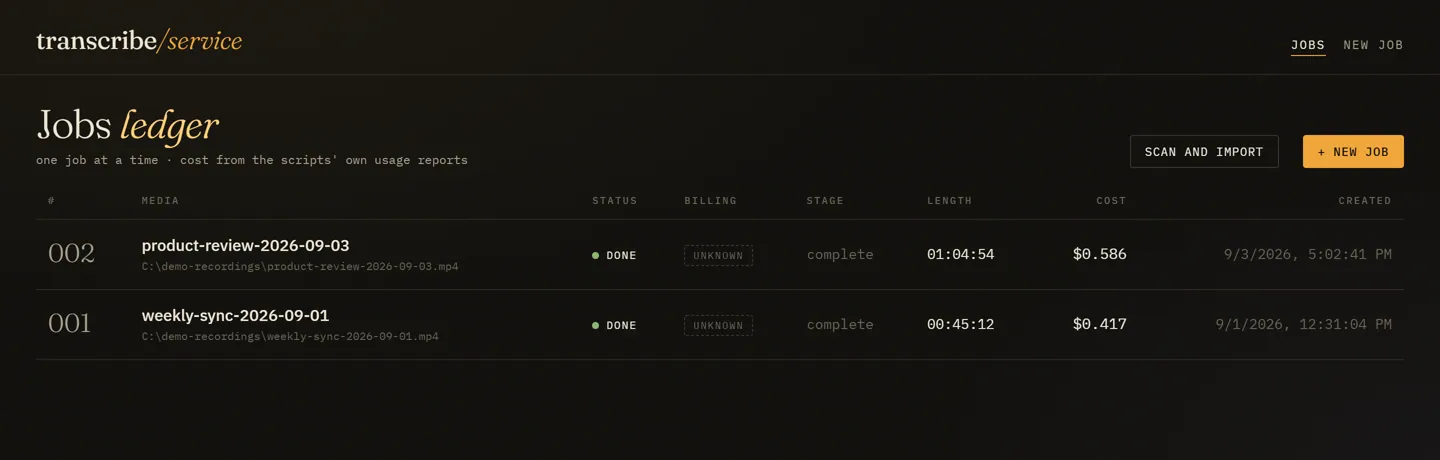
Meetings and screen recordings hold decisions that do not reach a document, and a transcript alone loses what was on screen. I needed a record I could audit: who said what, when, and what was shown at that moment.
The approach
I built the pipeline first as a skill that Claude and Codex could run and hardened it on recordings of up to about 90 minutes in three languages, including Bulgarian. Then I wrapped it as a local service with a job page and a ledger.
How it works
Parallel stages
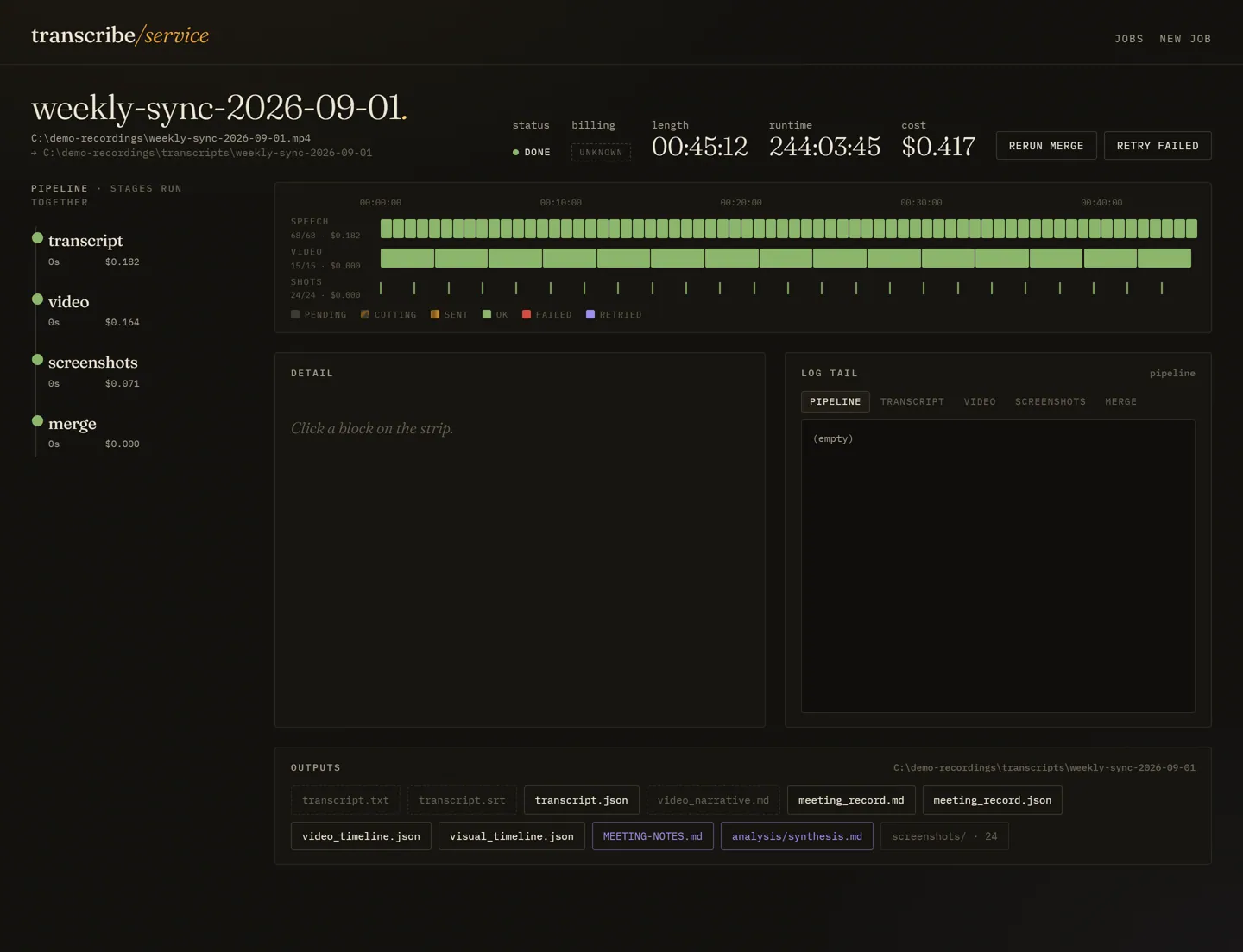
Transcript and video ingestion start together. Each video clip goes to the model as soon as ffmpeg has cut it, and one merge barrier, which can be re-run, assembles the document. Failed items retry at the end of a stage and from a Retry failed button in the UI.
Screenshots against a shared hash set
Screenshots are picked, grabbed and de-duplicated against a hash set shared across segments, so repeated frames collapse to one image.
One call site for model requests
All model calls go through one function. It rotates pooled API keys on 402 and 429 responses, retires a key on 401 and 403, and falls back from OpenRouter to Vertex AI with a client-side check for key expiry.
Billing mode per job
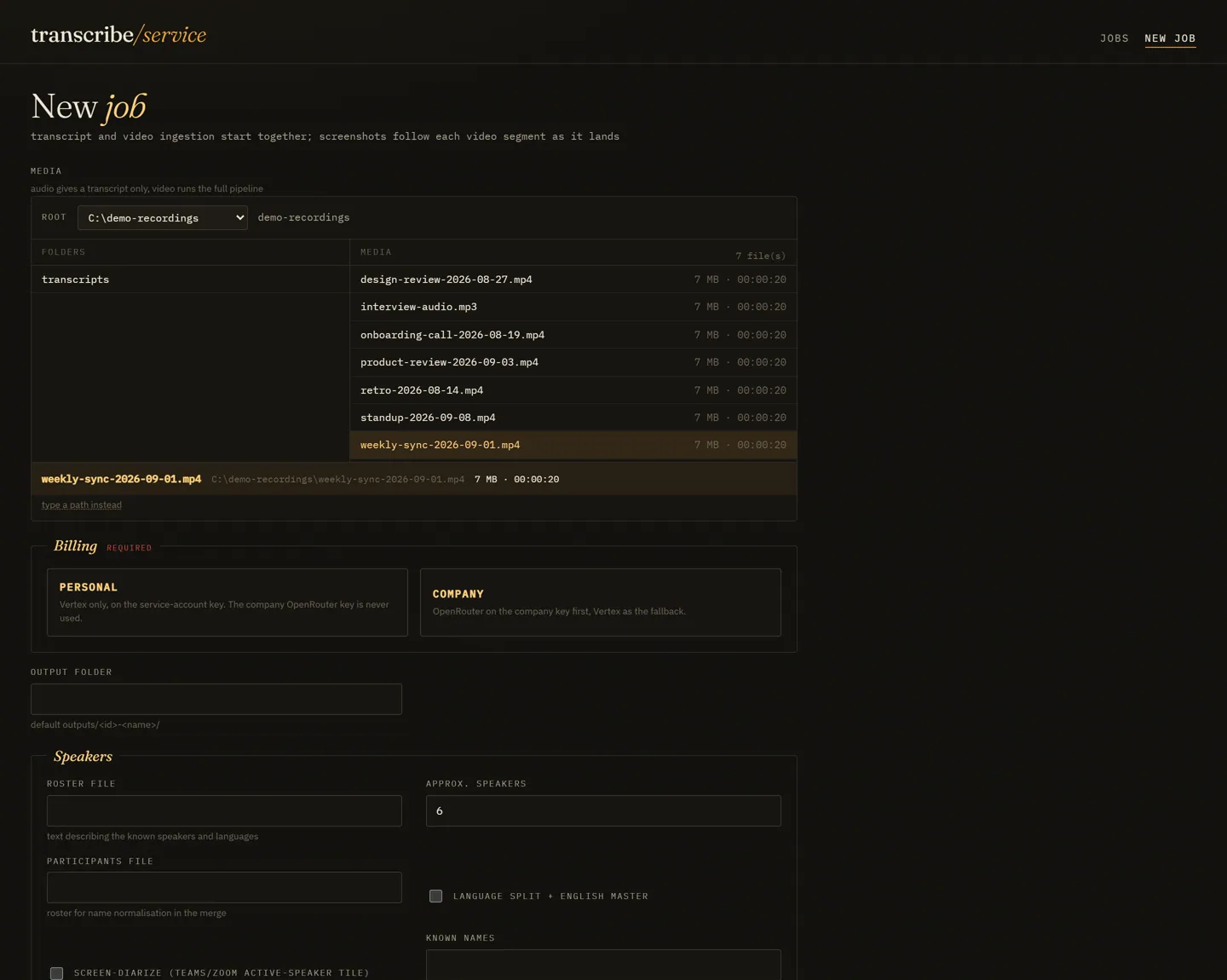
A job must declare a billing mode, and there is no default. The mode decides which providers the job may reach and wins over the environment file.
A test that reads the source
A test reads the source back to confirm that no key lives in the repository.
What I chose, and what lost
Chose
A billing mode declared on each job
Over
A default taken from the environment file
The mode is visible on the job and a stray environment setting cannot override it.
Outcome
The service has a licence, a contributing guide and three screenshots of its job page and ledger. A speaker-harmonising defect that cost 776 labels over two runs was still open in the skill version it grew from. The recordings it was validated on belong to clients and teams, so none are shown.
What comes next
Run it on a fresh set of recordings and confirm the speaker defect is gone.